
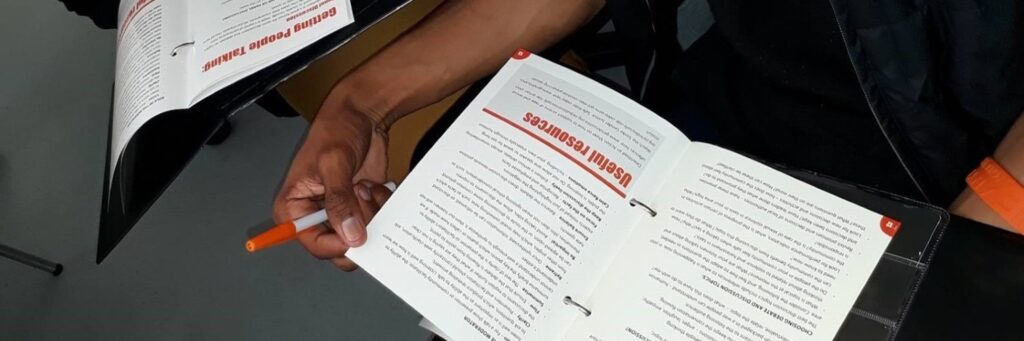
A production gets the attention. The discussion guide often does some of the quiet work behind it.
A powerful radio drama, documentary or video story can introduce new information, make complex issues more accessible, bring lived experiences to the foreground and open difficult conversations. But what happens after someone listens or watches?
A well-designed discussion guide helps get conversations going – giving presenters, facilitators, organisations and communities practical ways to explore issues, connect them to local realities and find out more.
At CMFD Productions, discussion and presenter guides accompany most of our productions – from radio dramas and documentaries to first-person digital and video stories. The idea is simple: create an easy-to-use resource that helps people move from listening or watching to discussion, dialogue and deeper exploration.
From content to conversation
Discussion guides do more than explain a production. Radio presenters use them to introduce programmes, frame key issues and host call-in shows – often bringing in local expertise and speakers to deepen the discussion. Community organisations and listening groups draw on the questions to spark conversation and reflection, while facilitators connect stories to local experiences.
This is where a guide can be particularly useful. The production may be shared across different countries, languages and communities, but the conversation around it can become local. Over the years, our guides have supported discussions on issues as diverse as women’s rights, sexual and reproductive health, gender-based violence, human trafficking, disaster risk, governance and civic participation.
What makes a useful discussion guide?
There is no single formula. What goes into a guide depends on the production, the issue and, most importantly, who will use it. But the best guides are practical, concise and easy to navigate.
Depending on the project, they might include background information, story or episode summaries, discussion questions, ideas for interviews or further reporting, useful organisations and experts, and links to services or additional information.
For sensitive issues, a guide can also help people navigate conversations with greater confidence and care. Some of our presenter guides, for example, have included guidance on discussing sensitive subjects with care, interviewing survivors and identifying appropriate sources for interviews and further information.
A good guide doesn’t prescribe the conversation. It gives people the information and tools to have a better one.
When the conversation travels further
Crossroads shows what that can look like in practice.
The six-part radio drama used humour and an unexpected storyline — a woman market trader and corrupt policeman switching bodies — to explore women’s rights and the Maputo Protocol. Versions were locally produced and adapted for audiences in different parts of Africa. The accompanying presenter guide provided background information, discussion questions, local contacts and ideas for exploring the issues further.
One Kenyan radio station described how the guide helped turn the broadcast into a wider local conversation:
“The guide helped me to follow up the drama episodes and gave me insight of the whole campaign for women rights… We invited two human rights activists… to explain further to the community in local language.” – Mulumbe FM, Kenya
And the conversations didn’t stop on air. In Kenya, listening groups took the drama into markets and church meetings, formed a local drama group and shared information through existing community structures. In Togo, groups explored adapting Crossroads into other formats so the story could reach communities that did not speak French.
Helping the conversation continue
Discussion guides may not be the most visible part of a communications project. But that doesn’t make them an afterthought. Designed well, they help people explore a story rather than simply consume it. They encourage questions, bring local voices and experiences into the discussion, and create opportunities for further learning, dialogue and action.
For us, that is the value of a good discussion guide. The production may get the limelight. The guide helps the conversation continue.